How Long Do Laser Cleaning Machines Last?
Laser cleaning machines are often described using impressive numbers—“50,000 hours,” “100,000 hours,” or even “decades of service life.” Yet in real factories, workshops, and shipyards, users frequently discover that machines with identical specifications age very differently. Some units remain stable and productive for more than a decade, while others show performance degradation, rising maintenance costs, or operational instability far earlier than expected. The reason is not marketing exaggeration alone, but a widespread misunderstanding of what “machine lifespan” actually means in industrial laser cleaning. Without clarity, buyers either overpay for unnecessary redundancy or underestimate long-term ownership costs. Understanding how long laser cleaning machines truly last requires an engineering-level view of system design, operating behavior, environment, and maintenance—not just brochure figures.
In real industrial conditions, a well-specified laser cleaning machine typically delivers 8–15 years of reliable service life, while the fiber laser source itself is commonly rated for 50,000–100,000 operating hours; however, the practical lifespan of the entire system is defined by optics, cooling, electronics, usage patterns, and maintenance discipline rather than the laser source alone.
This distinction is critical. A laser cleaning machine is not a single consumable device; it is a multi-subsystem industrial asset. Each subsystem ages at a different rate, and the overall lifespan is governed by the weakest link under real working conditions.
Table of Content
HIDE
Understanding What “Lifespan” Means in Laser Cleaning Equipment
In industrial practice, the word “lifetime” is used loosely, often without specifying which part of the machine is being discussed. This ambiguity is the root of most misunderstandings between suppliers and end users.
A laser cleaning machine has multiple overlapping lifespans, all of which matter depending on whether you are an engineer, an operator, or a financial decision-maker.
The Four Practical Lifetimes of a Laser Cleaning Machine
| Lifetime Dimension | Typical Range | What It Actually Represents |
|---|---|---|
| Laser source lifetime | 50,000–100,000 h | Gradual power degradation of the fiber laser |
| Mechanical system lifetime | 10–20 years | Frame, enclosure, wiring, structural integrity |
| Optical & consumable lifetime | Months to years | Protective lenses, focusing optics, mirrors |
| Economic / ROI lifetime | 5–12 years | Point where replacement is financially rational |
These lifetimes do not end simultaneously. In fact, they rarely align.
A machine may:
- Still function mechanically
- Still emit laser power
- Yet no longer clean efficiently, safely, or economically
This is why experienced users do not ask “How long does the laser last?” but instead ask “How long will this machine remain productive in my application?”
Fiber Laser Source Longevity: Long, Stable, and Often Misinterpreted
The fiber laser source is the most durable component in a modern laser cleaning machine. Compared with older CO₂ or lamp-pumped lasers, fiber lasers eliminate many traditional wear mechanisms.
Typical Fiber Laser Source Characteristics
| Parameter | Industry-Typical Value |
|---|---|
| Rated lifetime (MTBF) | 50,000–100,000 hours |
| Annual power degradation | ~1–3% |
| Failure mode | Gradual output reduction |
| Share of total machine cost | 30–45% |
Fiber lasers rarely experience sudden catastrophic failure. Instead, output power slowly decreases as laser diodes age. In laser cleaning applications, this gradual degradation is often tolerable far beyond the nominal rating.
For example, a 1000 W laser cleaner operating at 900 W after years of use may still deliver acceptable cleaning speed, especially for rust removal or paint stripping where absolute precision is less critical than in cutting or welding.
Engineering reality:
In most real-world cases, the fiber laser source outlasts other subsystems and is not the first reason a laser cleaning machine is retired.
Optical Components: The True Wear Items in Laser Cleaning
While fiber lasers are long-lived, optical components are not. Laser cleaning is inherently a dirty process. Rust, paint, oxide layers, and coatings are vaporized or ablated, producing fine particulates and metal fumes that directly threaten optical surfaces.
Typical Optical Component Service Life
| Optical Component | Typical Service Life | Replacement Frequency |
|---|---|---|
| Protective lens / window | 3–12 months | High |
| Focusing lens | 1–3 years | Medium |
| Scanning mirrors (pulsed systems) | 3–5 years | Low |
| Beam delivery windows | 1–2 years | Medium |
The protective lens is designed to fail first. It acts as a sacrificial barrier to protect more expensive internal optics. However, when inspection and replacement are neglected, contamination progresses inward, accelerating damage to critical components.
How Optical Degradation Affects Cleaning Performance
| Optical Condition | Practical Impact |
|---|---|
| Light contamination | Reduced efficiency |
| Coating micro-damage | Uneven cleaning patterns |
| Thermal lensing | Focus instability |
| Severe pitting | Safety risk, shutdown |
Many users incorrectly attribute declining cleaning performance to “laser aging,” when in reality the laser source remains healthy and the problem lies entirely in neglected optics.
Thermal Management: Cooling Systems as a Lifespan Gatekeeper
Heat is the silent enemy of every electronic and optical system. In laser cleaning machines, thermal management quality often determines whether a system reaches the upper or lower end of its expected lifespan range.
Cooling System Types and Durability
| Cooling Architecture | Typical Service Life | Primary Risk Factors |
|---|---|---|
| Air-cooled systems | 5–8 years | Dust accumulation, airflow blockage |
| Standard water chillers | 8–12 years | Pump wear, leaks |
| Industrial high-flow chillers | 10–15 years | Maintenance discipline |
Undersized or poorly maintained cooling systems cause:
- Accelerated laser diode aging
- Optical coating failure
- Power supply stress
- Control electronics instability
A laser cleaning machine may remain electrically “within specification” while still suffering long-term damage due to chronic thermal stress.
Electrical & Control Systems: Durable but Environment-Sensitive
Modern laser cleaning machines rely on robust power electronics and digital control systems. Under clean, stable conditions, these components are highly durable.
Typical Electrical Subsystem Lifetimes
| Component | Expected Service Life |
|---|---|
| Main power supply | 8–15 years |
| PLC / control boards | 10–20 years |
| Touchscreen HMI | 5–10 years |
| Safety interlocks | 10+ years |
Failures in this category are rarely caused by age alone. They are usually triggered by:
- Voltage instability
- Poor grounding
- High humidity
- Inadequate enclosure sealing
In harsh environments, electronics often define practical system lifespan, even when mechanical and laser components remain intact.
Usage Intensity and Operating Behavior: Why Identical Machines Age Differently
In real-world operations, two laser cleaning machines with the same model number can end up with dramatically different lifespans. The difference is rarely manufacturing quality; it is almost always how the machines are used day after day. Usage intensity, duty cycle, and operator behavior collectively determine whether a system reaches the upper end of its design life or deteriorates years earlier than expected.
Daily Operating Time and Its Long-Term Impact
| Daily Operating Time | Typical Duty Profile | Expected Practical Service Life |
|---|---|---|
| 1–2 hours | Intermittent maintenance | 14–18 years |
| 3–5 hours | Standard industrial use | 10–12 years |
| 6–8 hours | Heavy workshop use | 7–10 years |
| 10–12 hours | Shift-based operation | 5–8 years |
| Continuous / near-24h | Automated line | 4–6 years |
These figures are not theoretical. They reflect cumulative thermal load, optical exposure, and electronic stress. Laser cleaning machines are designed around thermal equilibrium assumptions. When a machine is allowed to cool between sessions, components experience far less long-term fatigue.
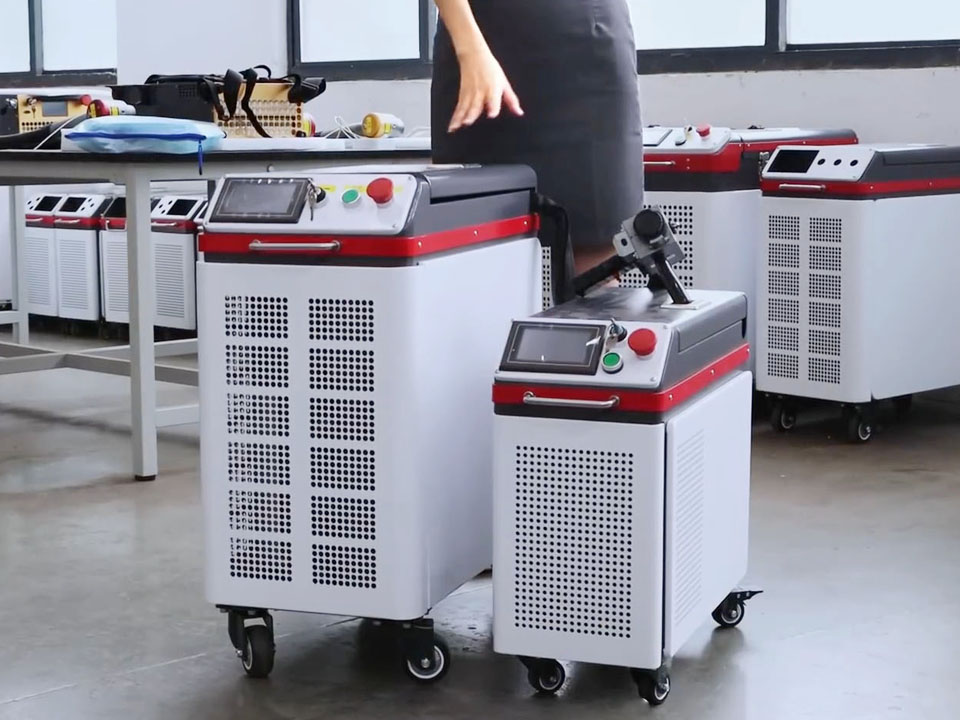
A common mistake is treating handheld or trolley-type laser cleaners as if they were production-line automation tools. While they can technically operate for long periods, they are not engineered for continuous high-load duty unless specifically designed as such. This mismatch alone accounts for a large percentage of “early failures” reported by end users.
Peak Power vs Average Power: A Hidden Lifespan Lever
Another overlooked factor is the difference between rated peak power and average delivered power. Many users run machines at maximum settings by default, assuming this is the most efficient approach. In reality, laser cleaning efficiency often increases nonlinearly with power, while component stress increases almost linearly.
Reducing average operating power by even 10–20% can:
- Lower internal temperatures significantly
- Reduce optical contamination rates
- Extend cooling system life
- Improve long-term stability
From an engineering perspective, it is almost always better to operate slightly below maximum capacity and maintain consistent output over many years than to chase marginal speed gains at the expense of system longevity.
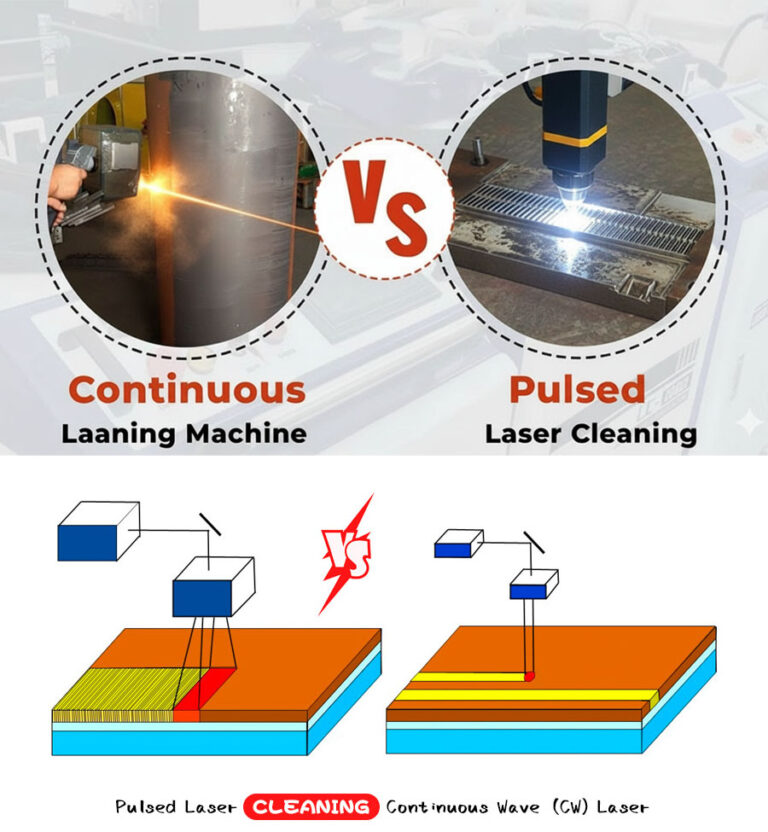
Pulsed and Continuous-Wave Systems: Different Aging Mechanisms
Laser cleaning machines generally fall into two technical categories: pulsed fiber laser systems and continuous-wave (CW) fiber laser systems. While both are widely used, they age differently over time.
Longevity-Oriented Comparison
| Characteristic | Pulsed Laser Cleaning | CW Laser Cleaning |
|---|---|---|
| Thermal accumulation | Low | High |
| Optical stress | Moderate | Higher |
| Substrate heat input | Minimal | Significant |
| Aging pattern | Gradual, predictable | Accelerated at high load |
| Typical system lifespan | Longer | Slightly shorter |
Pulsed systems deliver energy in short bursts, allowing heat to dissipate between pulses. This reduces cumulative thermal stress on optics, laser diodes, and surrounding electronics. As a result, pulsed laser cleaning machines tend to maintain stable performance over longer periods, especially in precision or medium-duty applications.
CW systems, by contrast, maintain continuous energy output. This makes them extremely effective for heavy rust, scale, and thick coatings, but it also means that thermal management quality becomes absolutely critical. When cooling is undersized or maintenance is lax, CW systems age faster.
The key takeaway is not that one technology is “better,” but that technology must match application severity. Misalignment between the two shortens lifespan far more than the choice of laser type itself.
Environmental Severity: The Silent Multiplier of Wear
The environment in which a laser cleaning machine operates has an outsized influence on its service life. Unlike power rating or duty cycle, environmental factors are often underestimated because their effects are gradual rather than immediate.
Environmental Stress Factors and Their Effects
| Environmental Factor | Long-Term Impact on Machine |
|---|---|
| High dust / oxide concentration | Rapid optical contamination |
| High humidity | Electrical corrosion, insulation degradation |
| Poor ventilation | Heat accumulation |
| Chemical vapors | Seal and coating degradation |
| Outdoor or semi-outdoor use | Accelerated aging across subsystems |
Industry-Based Severity Comparison
| Industry | Typical Environment | Expected Service Life |
|---|---|---|
| Mold manufacturing | Clean, controlled | 12–15 years |
| Automotive repair | Moderate dust | 9–12 years |
| Structural steel fabrication | Heavy dust | 7–10 years |
| Shipbuilding / ship repair | Extremely harsh | 5–8 years |
| Heavy equipment refurbishment | Very harsh | 5–7 years |
A laser cleaner operating in a controlled mold shop can realistically last nearly twice as long as the same model working on a shipyard dock. This difference has nothing to do with build quality and everything to do with exposure severity.
Maintenance Discipline: Turning Design Life into Real Life
Maintenance is not simply about avoiding breakdowns; it is the primary mechanism by which users control the aging curve of a laser cleaning machine.
Preventive Maintenance Practices That Matter
| Maintenance Activity | Typical Frequency | Effect on Lifespan |
|---|---|---|
| Protective lens inspection | Weekly | Prevents cascading optical damage |
| Optical cleaning | As needed | Maintains beam quality |
| Cooling system inspection | Monthly | Prevents thermal stress |
| Electrical connection check | Quarterly | Avoids intermittent failures |
| Full system calibration | Annually | Restores efficiency |
Machines that follow a structured maintenance program consistently outlast those that rely on reactive repairs.
Maintenance Level vs Lifespan Outcome
| Maintenance Discipline | Relative Lifespan |
|---|---|
| Neglected | 1.0× |
| Basic | 1.3× |
| Structured / professional | 1.8–2.2× |
In practical terms, a laser cleaning machine expected to last 6–8 years under poor maintenance can often deliver 12–15 years of service when cared for properly.
Economic Life Versus Physical Life: Knowing When to Replace
A laser cleaning machine can remain physically functional long after it stops making economic sense to keep it in operation. This distinction is especially important for businesses focused on productivity and return on investment.
Common Triggers for Replacement
| Trigger | Underlying Reason |
|---|---|
| Insufficient cleaning speed | Throughput bottleneck |
| Rising maintenance cost | Diminishing returns |
| New materials or coatings | Power or pulse mismatch |
| Updated safety standards | Compliance pressure |
| Automation requirements | Labor optimization |
Typical Replacement Cycles by Industry
| Industry | Typical Economic Replacement Cycle |
|---|---|
| Job shops | 8–10 years |
| Automotive OEMs | 6–8 years |
| Aerospace manufacturing | 5–7 years |
| Shipbuilding | 5–6 years |
From a financial perspective, the optimal time to replace a machine is often before major failure, when improved efficiency and reliability justify new investment.
Practical Lifespan Summary
| Machine Category | Expected Practical Lifespan |
|---|---|
| Low-power laboratory systems | 12–18 years |
| Handheld industrial laser cleaners | 8–12 years |
| High-power CW laser systems | 6–10 years |
| Automated laser cleaning lines | 4–8 years |
These ranges assume proper specification, reasonable operating margins, and consistent maintenance.
Final Perspective: How Long Should a Laser Cleaning Machine Last?
A laser cleaning machine is not a consumable tool; it is a long-term industrial asset. When correctly selected and responsibly operated, it should deliver many years of predictable, stable performance. The machines that last the longest are not necessarily the most expensive, but the ones whose design, application, and operating discipline are aligned.
If a laser cleaning machine fails early, the cause is almost never the fiber laser source itself. In nearly all cases, premature aging can be traced to misapplication, excessive duty cycle, harsh environment, or neglected maintenance.
A Straight Conversation Before You Decide
At BOGONG Machinery, we approach laser cleaning systems from an engineer’s perspective rather than a brochure claim. We help customers match power level, cooling architecture, and configuration to real workloads and real environments, so the machine lasts as long as the business plan requires.
If you are investing in laser cleaning equipment and want it to remain productive year after year—not just impressive on paper—we are ready to talk.
Contact BOGONG Machinery to build a laser cleaning solution designed for durability, stability, and long-term value.
Talk to Bogong Laser Cleaning Machines ExpertsGet a Quote or Customized Solution for Your Application

-
Whatsapp: +86-15665870861
-
Email: info@bogongcnc.com