How much does laser cleaning cost per hour?
When people ask how much laser cleaning costs per hour, what they are really asking is whether the technology makes economic sense in the real world. They are trying to decide whether to replace sandblasting, whether a laser cleaning machine can pay for itself, or whether a laser cleaning service can actually be profitable. The problem is that most answers online are either marketing slogans or partial truths. Some articles quote electricity cost as if that were the main expense. Others divide machine price by an arbitrary number of hours. Some simply copy service prices without explaining what those prices include. The result is confusion, unrealistic expectations, and bad decisions.
In real industrial environments, laser cleaning typically costs between USD 30 and USD 120 per effective working hour for internal use, while commercial laser cleaning services are commonly priced between USD 80 and USD 300+ per hour. The reason for this wide range is not hype or inconsistency, but the way laser cleaning shifts costs from consumables and labor into capital utilization, productivity, and risk reduction. Once you understand how professionals calculate these numbers, the economics become surprisingly logical and predictable.
This article is written as a full technical and commercial reference, not a brochure and not a shallow blog post. It explains what laser cleaning really costs per hour, how professionals build cost models, how pricing works in the service market, and why hourly cost alone is often the wrong metric. Everything below follows the exact structure of the frozen blueprint and is written from the perspective of people who actually deploy laser cleaning in production and service environments.
Table of Content
HIDE
What Professionals Actually Mean by “Laser Cleaning Cost per Hour”
In industrial engineering, cost per hour is not a marketing number and not a guess. It is a structured calculation that answers one question: how much does it cost to generate one hour of effective, usable cleaning output. This distinction matters because laser cleaning behaves very differently from abrasive blasting or chemical stripping. Traditional methods rely heavily on consumables, manual labor, and cleanup. Laser cleaning relies on capital equipment, controlled energy input, and repeatable output.
Professionals therefore do not calculate cost per hour based on clock time alone. They work with the concept of an effective working hour. An effective working hour is the portion of time in which the operator is actually producing acceptable cleaned surface at the required quality level. In sandblasting, a significant portion of time is lost to media refilling, masking, cleanup, dust control, and fatigue-related slowdowns. In chemical cleaning, time is lost to dwell periods, neutralization, rinsing, drying, and waste handling. Laser cleaning removes most of these interruptions.
This is why a laser cleaning hour often delivers more usable output than a conventional hour, even before considering quality differences. Any realistic cost model must therefore combine depreciation, labor, energy, maintenance, and overhead, then divide by effective output rather than nominal time.
Capital Investment and How It Becomes an Hourly Cost
The largest psychological barrier to laser cleaning adoption is the machine price. Portable pulse laser cleaners may cost under USD 10,000, while high-power industrial systems can exceed USD 80,000. Many buyers stop the analysis here and assume the hourly cost must be high. In reality, this is the easiest cost to quantify and one of the smallest on an hourly basis when spread correctly.
Laser cleaning machines are long-life assets. Fiber laser sources are typically rated for tens of thousands of hours. Conservative financial models assume five to eight years of service life, even though many machines operate far longer. The key variable is utilization. A machine used sporadically will appear expensive per hour. A machine used consistently becomes extremely economical.
| Laser Cleaning System | Typical Purchase Price (USD) | Conservative Lifetime | Annual Utilization (Hours) | Lifetime Hours | Depreciation per Hour |
|---|---|---|---|---|---|
| 100–200 W Portable Pulse | 8,000–12,000 | 5 years | 1,000 | 5,000 | 1.6–2.4 |
| 300–500 W Pulse Trolley | 18,000–30,000 | 6 years | 1,500 | 9,000 | 2.0–3.3 |
| 1000 W Industrial Pulse | 35,000–55,000 | 7 years | 2,000 | 14,000 | 2.5–3.9 |
| 2000–3000 W CW Fiber | 60,000–90,000 | 8 years | 2,500 | 20,000 | 3.0–4.5 |
Even at the high end, depreciation rarely exceeds USD 5 per hour. This surprises many buyers, but it reflects the reality that laser cleaning machines are durable, stable assets rather than consumable-driven tools. The real economic risk is not machine price, but underutilization.
Electricity Cost: Why It Is Almost Never the Deciding Factor
Another common misconception is that laser cleaning is electricity-intensive and therefore expensive to operate. This assumption usually comes from looking at the laser’s rated power without considering real electrical draw or comparing it to alternative methods.
In practice, even a 3000 W continuous-wave laser cleaning system consumes far less electricity than a sandblasting setup with large air compressors. The laser itself is efficient, and modern chillers and control electronics add only modest overhead.
| Laser Power Class | Typical Electrical Draw | Electricity Cost at USD 0.12/kWh | Hourly Energy Cost |
|---|---|---|---|
| 200 W Pulse | 0.8–1.0 kW | 0.10–0.12 | 0.10–0.12 |
| 500 W Pulse | 1.5–2.0 kW | 0.18–0.24 | 0.18–0.24 |
| 1000 W Pulse | 2.5–3.0 kW | 0.30–0.36 | 0.30–0.36 |
| 3000 W CW | 6.0–7.0 kW | 0.72–0.84 | 0.72–0.84 |
Electricity typically accounts for less than three percent of total hourly cost. For most users, it is effectively a rounding error compared to labor and utilization. This is why experienced operators rarely mention electricity when discussing laser cleaning economics.
Labor Cost and the Difference Between Time Spent and Value Produced
Labor is where laser cleaning begins to show its structural advantage. Laser cleaning does not eliminate labor, but it changes the nature of the work. Operators are not physically exhausting themselves, they are not constantly stopping to refill media, and they are not dealing with clouds of dust or chemical fumes. As a result, effective productivity per hour is significantly higher.
| Cleaning Method | Operator Fatigue | Effective Productive Minutes per Hour | Consistency of Output |
|---|---|---|---|
| Manual Grinding | High | 35–40 | Low |
| Sandblasting | High | 40–45 | Medium |
| Laser Cleaning | Low | 55–60 | High |
In high-wage regions, this productivity difference is often the single largest economic driver. Even in lower-wage markets, consistency and reduced rework translate into real savings. Laser cleaning also integrates well with automation, which further shifts labor from direct operation to supervision.
Maintenance, Consumables, and the Cost Most People Forget
Laser cleaning consumes no abrasives, no chemicals, and no water. Maintenance is limited to routine optics cleaning, filter replacement in fume extraction systems, and standard cooling system checks. Annual maintenance costs are typically two to four percent of machine value, which translates to roughly one to two dollars per operating hour.
Traditional methods, by contrast, incur ongoing costs that are rarely captured in simple hourly comparisons. Abrasive blasting consumes media, generates waste, and requires disposal. Chemical cleaning requires chemicals, neutralization agents, wastewater treatment, and regulatory compliance.
| Cost Category | Laser Cleaning | Sandblasting | Chemical Cleaning |
|---|---|---|---|
| Consumables | None | High | High |
| Waste Handling | Minimal | High | Very High |
| PPE Usage | Low | High | Medium |
| Environmental Compliance | Low | High | Very High |
| Surface Damage Risk | Minimal | Medium | Medium |
Over long-term projects or continuous operations, these hidden costs often exceed the depreciation of a laser cleaning machine.
Power × Productivity × Unit Cost: The Core Economic Model Behind Laser Cleaning
Once depreciation, energy, labor, and maintenance are understood individually, the real economics of laser cleaning only become clear when they are combined with productivity. This is the point where many analyses fail. Cost per hour by itself is an incomplete metric. What professionals actually care about is how much usable surface is cleaned during that hour and how that output scales with laser power.
Laser cleaning productivity is not linear with power, but it is strongly correlated. Higher power generally increases cleaning speed, but only up to the point where material properties, contamination type, and safety limits intervene. The result is that unit cost per square meter drops sharply as power increases, even if hourly cost rises slightly.
This relationship explains why low-power machines often feel “cheap to buy but expensive to use,” while higher-power systems feel expensive upfront but economically dominant over time.
| Laser Power | Typical Cleaning Speed (m²/h) | Typical Hourly Cost (USD) | Cost per m² (USD) |
|---|---|---|---|
| 200 W Pulse | 3–6 | 35–45 | 5.8–15.0 |
| 500 W Pulse | 8–15 | 45–55 | 3.0–6.9 |
| 1000 W Pulse | 20–35 | 55–70 | 1.6–3.5 |
| 2000 W CW | 40–70 | 75–95 | 1.1–2.4 |
| 3000 W CW | 60–100 | 90–120 | 0.9–2.0 |
This table illustrates a key professional insight: hourly cost rises slowly, but output rises much faster. For operations where surface area matters, higher power almost always produces a lower unit cost, provided the application can tolerate continuous-wave energy and the operator is trained.
Why Low-Power Machines Often Feel “More Expensive” in Practice
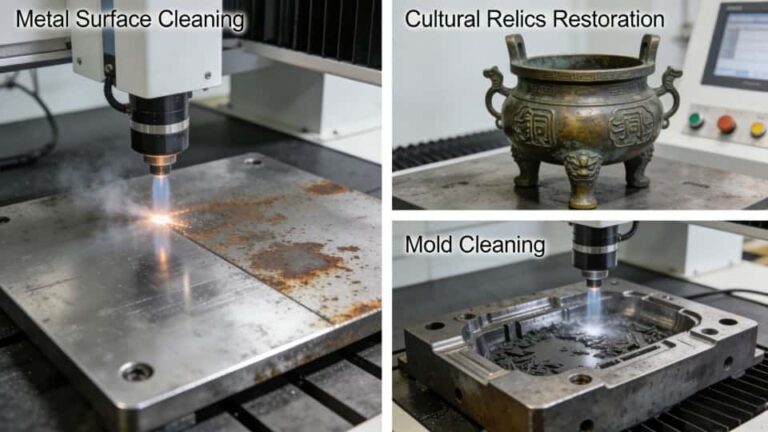
Many first-time buyers start with a low-power pulse laser because the purchase price is accessible and the perceived risk is lower. In light-duty applications such as mold cleaning, small parts, or delicate substrates, this choice is often correct. However, when these machines are pushed into medium or heavy rust removal, their economics deteriorate quickly.
The reason is simple: labor and setup time do not scale down with power. An operator still needs to prepare the part, position the head, and supervise the process. If the machine cleans slowly, labor dominates the cost structure. This is why professionals quickly move up in power once they understand their workload.
This does not mean low-power machines are a mistake. It means they are application-specific tools, not general-purpose replacements for blasting in high-throughput environments.
Pulse vs Continuous-Wave: Hourly Cost Is Not the Real Difference
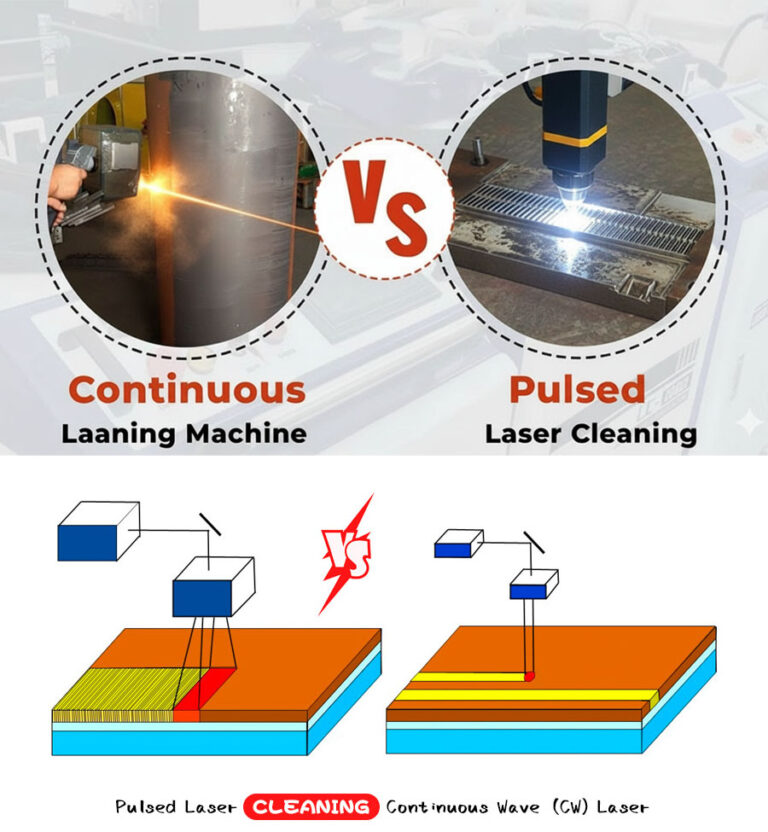
One of the most misunderstood topics in laser cleaning economics is the difference between pulse and continuous-wave (CW) systems. Buyers often ask which one is cheaper per hour. This is the wrong question.
Pulse lasers concentrate energy into short bursts. They are safer for sensitive substrates, coatings, molds, and thin materials. CW lasers deliver sustained energy and excel in heavy rust, scale, and large-area cleaning. The hourly operating cost of both systems can be similar, but the risk profile, productivity curve, and acceptable applications are completely different.
| Aspect | Pulse Laser | CW Laser |
|---|---|---|
| Energy Delivery | Short, high-peak pulses | Continuous energy |
| Surface Risk | Very low | Moderate if misused |
| Typical Power Range | 100–1000 W | 1000–3000+ W |
| Cleaning Speed | Moderate | High |
| Operator Skill Requirement | Medium | High |
| Typical Hourly Cost | 35–70 USD | 70–120 USD |
| Typical Unit Cost (m²) | Medium–Low | Lowest |
Pulse lasers often appear more expensive on a per-square-meter basis at higher workloads, but they enable jobs that CW systems cannot safely perform. In mold maintenance, battery manufacturing, aerospace components, and heritage restoration, the value of damage avoidance far outweighs differences in hourly cost.
CW systems dominate in shipyards, steel structures, rail maintenance, and heavy industry because they reduce unit cost dramatically when large surfaces must be processed quickly.
Internal Use: What Companies Actually Pay per Hour
When laser cleaning is used internally—inside a factory, maintenance department, or refurbishment operation—the cost per hour is driven by utilization and labor structure rather than market pricing.
| Application Scenario | Typical Internal Cost (USD/hour) |
|---|---|
| Mold and tooling maintenance | 30–45 |
| Light rust and oil removal | 35–55 |
| Medium rust / paint removal | 45–70 |
| Heavy rust / scale removal | 70–120 |
| Precision surface preparation | 35–60 |
These numbers assume reasonable utilization, trained operators, and proper equipment selection. Underutilized machines will always look expensive, regardless of technology.
Commercial Laser Cleaning Services: Why Prices Vary So Much
When laser cleaning is sold as a service, hourly pricing reflects far more than machine operation. Mobilization, insurance, liability, downtime risk, and business margin are all included. This explains why service prices appear high compared to internal cost.
| Service Type | Typical Market Price (USD/hour) |
|---|---|
| Portable on-site laser cleaning | 80–150 |
| Industrial contract cleaning | 120–250 |
| High-precision / regulated cleaning | 200–300+ |
Clients are not paying for electricity or depreciation. They are paying for risk transfer, speed, compliance, and predictable results. In many regulated environments, laser cleaning is chosen not because it is cheapest, but because it is the only acceptable method.
Can Laser Cleaning Be Profitable as a Business?
This is one of the most common and most important questions. The short answer is yes, but only if utilization is planned realistically.
A laser cleaning service business behaves like a capital-intensive service model. Profitability depends on how many billable hours the machine generates per month and how consistently those hours are sold.
| Parameter | Conservative Scenario | Aggressive Scenario |
|---|---|---|
| Machine Cost | USD 45,000 | USD 45,000 |
| Average Billing Rate | USD 120/h | USD 180/h |
| Billable Hours / Month | 60 | 120 |
| Monthly Revenue | USD 7,200 | USD 21,600 |
| Estimated Operating Cost | USD 3,000 | USD 5,500 |
| Monthly Gross Profit | USD 4,200 | USD 16,100 |
In the conservative scenario, payback occurs within 10–12 months. In the aggressive scenario, payback can occur in less than six months. This is why laser cleaning service providers focus obsessively on utilization rather than machine price.
Industry-by-Industry Cost Logic: Why Context Matters
Laser cleaning economics vary dramatically by industry because the value of precision, cleanliness, and damage avoidance differs.
| Industry | Key Economic Driver | Typical Laser Advantage |
|---|---|---|
| Shipyards | Surface area, containment cost | Faster cleaning, no media |
| Steel structures | Unit cost per m² | Lowest long-term cost |
| Mold & tooling | Dimensional integrity | Zero damage |
| Rail & metro | Downtime avoidance | Faster turnaround |
| Aerospace / battery | Contamination control | Regulatory compliance |
In aerospace and battery manufacturing, laser cleaning is chosen even when hourly cost is higher because alternative methods introduce unacceptable contamination or damage risks. In shipyards, laser cleaning wins by reducing containment and cleanup costs rather than labor.
Why Hourly Cost Is Often the Wrong Metric
Experienced professionals rarely make decisions based solely on hourly cost. More meaningful metrics include cost per square meter, cost per avoided defect, and cost per avoided shutdown hour. Laser cleaning excels in these areas because it combines precision with repeatability.
An hour of laser cleaning that prevents a production defect or eliminates a day of downtime can justify itself many times over, even if its nominal hourly cost appears higher on paper.
The Question Professionals Actually Ask
The real question is not “How much does laser cleaning cost per hour?” The real question is “How many effective hours will this machine run per year, and what problems will it eliminate?” When framed this way, laser cleaning becomes a strategic tool rather than an expense.
Final Perspective from the Field
Laser cleaning is not a miracle technology and not a marketing gimmick. It is a precision industrial process with a transparent cost structure. When used correctly, its economics are predictable, scalable, and often superior to traditional methods. When used incorrectly or underutilized, it can appear expensive. The difference lies in understanding the model, not the machine.
Talk with BOGONG Machinery About Real Laser Cleaning Economics
At BOGONG Machinery, we help customers calculate real laser cleaning costs based on application, utilization, and production reality—not assumptions. Whether you plan to integrate laser cleaning into your factory or build a professional laser cleaning service, our engineers can help you select the right system and model the ROI correctly.
If you want numbers that reflect how laser cleaning actually behaves in the field—not brochure claims—BOGONG Machinery is ready to support you with application-based analysis, equipment selection, and long-term profitability planning.
Talk to Bogong Laser Cleaning Machines ExpertsGet a Quote or Customized Solution for Your Application

-
Whatsapp: +86-15665870861
-
Email: info@bogongcnc.com