Is laser cleaning more effective than sandblasting?
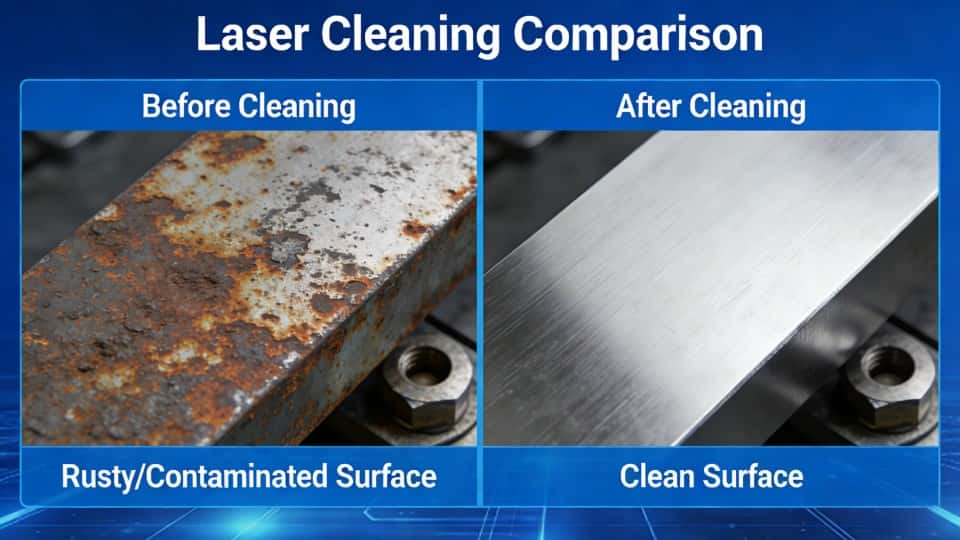
Corrosion, paint buildup, oxide scaling, oil contamination, and coating failure are daily operational challenges in heavy industry. For decades, sandblasting has been the dominant solution for surface preparation. However, modern manufacturers are increasingly questioning whether abrasive blasting remains the most effective method in terms of precision, environmental compliance, long-term cost, substrate integrity, and downstream process compatibility. Choosing the wrong surface treatment method can result in embedded abrasives, coating delamination, dimensional damage, environmental penalties, and unnecessary operational expense.
Laser cleaning is more effective than sandblasting in precision control, substrate protection, environmental compliance, automation compatibility, and long-term operational efficiency. However, sandblasting may still outperform laser cleaning in extremely heavy-scale removal over large rough structural surfaces where precision is not required. The most effective solution depends on material type, contamination thickness, quality requirements, and total lifecycle cost considerations.
To answer this question rigorously, we must analyze cleaning mechanisms, material interaction physics, surface integrity, environmental impact, operating cost, process scalability, and industrial application scenarios.
Table of Content
HIDE
Fundamental Cleaning Mechanisms: Physical Impact vs. Photonic Ablation
Sandblasting Mechanism
Sandblasting (abrasive blasting) operates through high-velocity mechanical impact. Abrasive particles such as silica sand, garnet, aluminum oxide, or steel grit are propelled toward the substrate at speeds of 50–110 m/s. Contaminants are removed by:
- Impact fracture
- Surface erosion
- Micro-cutting
- Plastic deformation
This process removes rust, scale, paint, and surface oxides by physically abrading both contamination and part of the base metal.
Laser Cleaning Mechanism
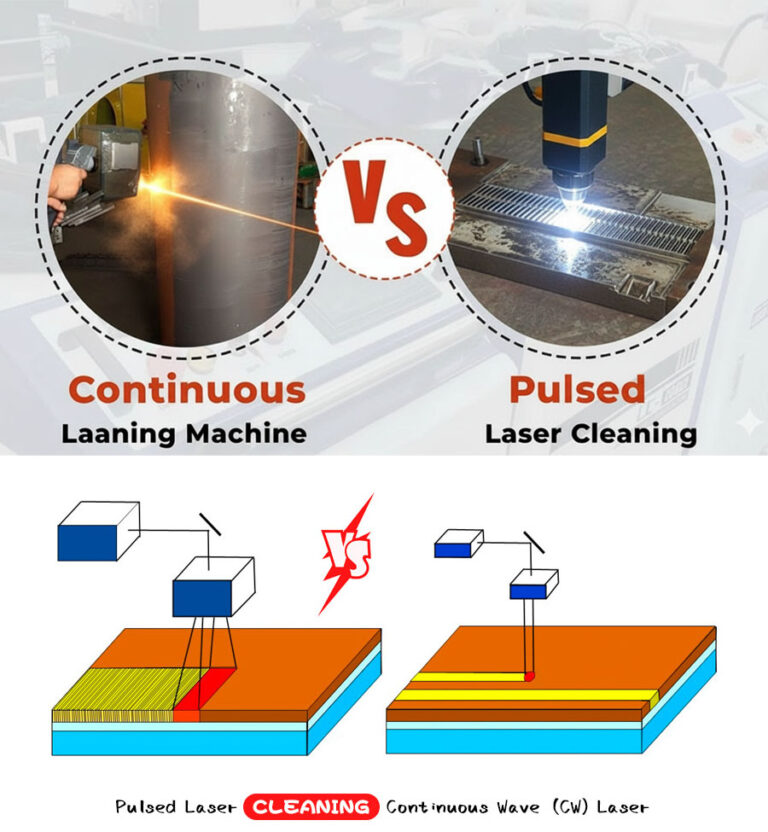
Laser cleaning uses high-energy pulsed fiber lasers to induce:
- Photothermal ablation
- Plasma micro-explosion
- Selective oxide absorption
- Layer-by-layer vaporization
The laser energy is absorbed preferentially by contaminants rather than the base metal, allowing selective removal without mechanical contact.
Mechanism Comparison Table
| Parameter | Sandblasting | Laser Cleaning |
|---|---|---|
| Removal Principle | Mechanical impact | Photonic ablation |
| Contact Type | Direct abrasive contact | Non-contact |
| Base Metal Erosion | Yes | Minimal |
| Selectivity | Low | High |
| Surface Precision | Low–Moderate | High |
From a materials science perspective, laser cleaning offers superior selectivity and minimal substrate disruption.
Surface Integrity and Metallurgical Impact
One of the most critical industrial concerns is substrate preservation.
Sandblasting Effects
- Surface roughening
- Micro-pitting
- Dimensional loss
- Work hardening
- Embedded abrasive particles
Embedded abrasives can cause long-term corrosion initiation sites.
Laser Cleaning Effects
- Minimal heat-affected zone (with pulsed systems)
- No mechanical stress
- No foreign particle embedding
- Controlled surface roughness
Surface Roughness Comparison
| Method | Typical Ra (µm) | Metal Removal Depth |
|---|---|---|
| Sandblasting | 2.5–6.5 | 10–75 µm |
| Laser Cleaning | 1.0–3.0 (adjustable) | <10 µm |
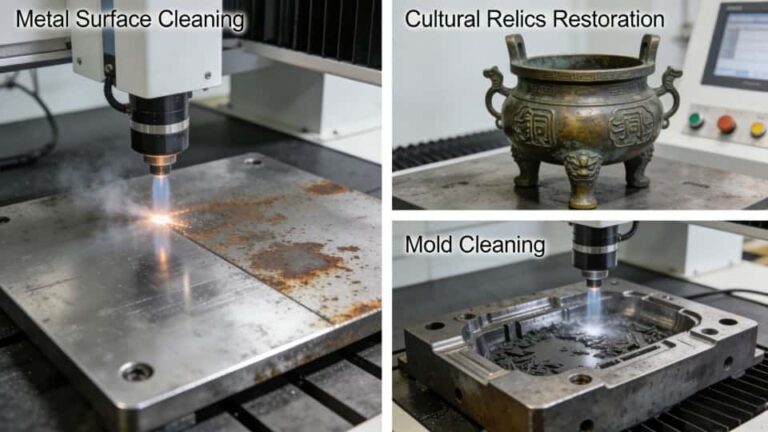
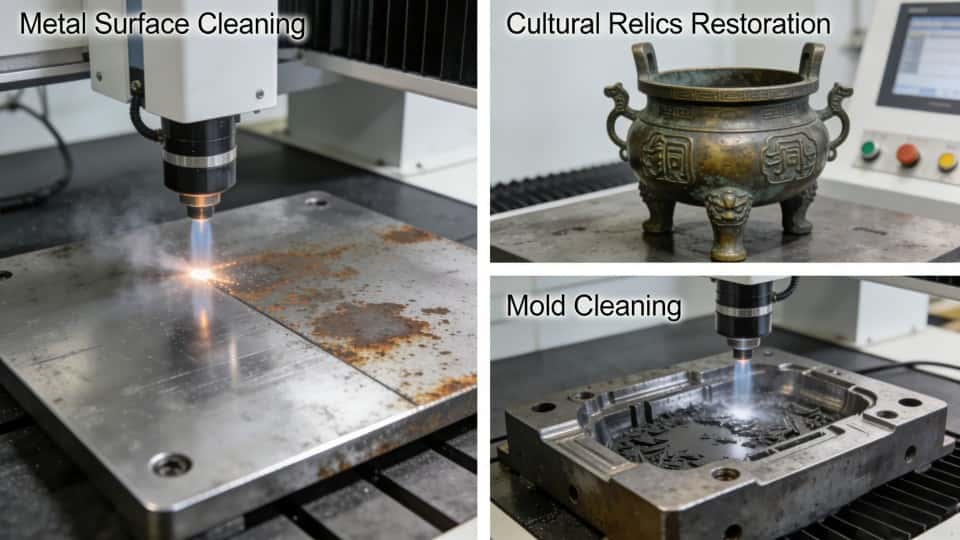
Laser cleaning preserves structural tolerances, making it superior for precision components, molds, aerospace parts, and automotive restoration.
Cleaning Efficiency by Contamination Type
Effectiveness depends heavily on contamination thickness and type.
Rust Removal
Laser cleaning excels at:
- Thin to moderate corrosion
- Oxide layers
- Flash rust
- Heat tint removal
Sandblasting excels at:
- Thick heavy scaling
- Marine structural corrosion
- Large-area rough cleaning
Paint Removal
Laser systems remove:
- Powder coatings
- Epoxy paints
- Oil-based coatings
- Thermal spray residues
With higher control than blasting.
Efficiency Matrix
| Contaminant | Sandblasting Effectiveness | Laser Cleaning Effectiveness |
|---|---|---|
| Light Rust | High | Very High |
| Heavy Scale | Very High | Moderate–High |
| Thin Paint | High | Very High |
| Precision Mold Residue | Low | Very High |
| Oil & Grease | Low | Moderate |
Laser cleaning becomes significantly more effective in applications requiring precision.
Environmental and Regulatory Impact
Environmental compliance is increasingly critical.
Sandblasting Environmental Issues
- Silica dust hazards
- Abrasive waste disposal
- High noise levels (>100 dB)
- Dust containment requirements
- Worker respiratory risks
Laser Cleaning Environmental Profile
- No abrasive media
- No chemical solvents
- Captured particulate via extraction
- Lower noise levels (~70 dB)
- Reduced waste generation
Environmental Impact Comparison
| Factor | Sandblasting | Laser Cleaning |
|---|---|---|
| Dust Generation | High | Low |
| Media Waste | High | None |
| Chemical Waste | None | None |
| Noise Level | High | Moderate |
| Regulatory Risk | High | Low |
Laser cleaning is clearly more sustainable and regulation-friendly.
Operational Cost Analysis (Total Lifecycle)
Initial Investment
| Equipment | Approximate Cost |
|---|---|
| Sandblasting Setup | $10,000–$40,000 |
| Industrial Laser Cleaner | $20,000–$120,000 |
Laser systems require higher capital investment.
Operational Cost Comparison
| Cost Component | Sandblasting | Laser Cleaning |
|---|---|---|
| Consumables | Abrasives continuous | None |
| Waste Disposal | Ongoing | Minimal |
| Labor Intensity | High | Moderate |
| Maintenance | Moderate | Low |
| Energy Consumption | Moderate | Moderate |
Over 3–5 years, laser cleaning often surpasses sandblasting in cost efficiency due to elimination of consumables and waste management.
Automation and Industry 4.0 Integration
Laser systems integrate easily with:
- Robotic arms
- CNC platforms
- Production lines
- Automated scanning systems
Sandblasting is difficult to automate with precision.
Laser cleaning is more compatible with smart manufacturing.
Safety Comparison
| Risk Category | Sandblasting | Laser Cleaning |
|---|---|---|
| Respiratory Risk | High | Low |
| Eye Injury | Moderate | Controlled with PPE |
| Noise Hazard | High | Low |
| Surface Rebound Risk | High | None |
Proper laser safety training is required, but overall risk profile is lower.
Industrial Application Case Studies
Automotive Restoration
Laser cleaning preserved original metal thickness and prevented panel warping. Sandblasting caused measurable thinning.
Aerospace Component Cleaning
Laser cleaning met strict dimensional tolerances and avoided foreign object debris (FOD). Sandblasting unacceptable.
Shipyard Structural Cleaning
Sandblasting faster for massive hull surfaces. Laser used selectively for sensitive areas.
Productivity Comparison
| Metric | Sandblasting | Laser Cleaning |
|---|---|---|
| Cleaning Speed (Heavy Scale) | Faster | Moderate |
| Cleaning Speed (Precision Rust) | Moderate | Faster |
| Setup Time | High (containment) | Low |
| Post-Cleanup | Extensive | Minimal |
Quality Control and Repeatability
Laser cleaning offers:
- Adjustable pulse energy
- Controlled scanning speed
- Digital repeatability
- Consistent output
Sandblasting depends heavily on operator technique.
Laser cleaning provides higher process control consistency.
Is Laser Cleaning Always Superior?
No industrial method is universally superior. Laser cleaning is more effective when:
- Precision is required
- Substrate protection is critical
- Environmental compliance matters
- Automation integration is needed
- Surface selectivity is important
Sandblasting may remain preferable when:
- Large rough steel structures
- Extreme thick corrosion
- Low capital budget environments
- Speed outweighs precision
Long-Term Performance Impact
Laser cleaning reduces:
- Coating failure rates
- Embedded contamination
- Micro-crack initiation
- Maintenance frequency
Thus improving long-term structural durability.
Final Evaluation
From a technical, environmental, and lifecycle cost perspective, laser cleaning is more effective than sandblasting in precision industrial applications, high-value components, regulated environments, and automated manufacturing settings. Sandblasting remains useful in heavy-scale structural applications where surface precision is not critical and capital constraints dominate.
Laser cleaning represents the future of intelligent surface preparation, while sandblasting remains a legacy but still practical method in certain large-scale industrial scenarios.
Let’s Choose the Right Solution for Your Industry
At BOGONG Machinery, we engineer industrial-grade fiber laser cleaning systems designed for high precision, durability, and intelligent manufacturing integration. If you are evaluating whether laser cleaning can replace sandblasting in your specific application, our technical team can analyze your material, corrosion profile, production scale, and compliance requirements to provide a data-driven recommendation.
Contact BOGONG Machinery today to explore the most effective surface preparation solution tailored to your operational goals.
Talk to Bogong Laser Cleaning Machines ExpertsGet a Quote or Customized Solution for Your Application

-
Whatsapp: +86-15665870861
-
Email: info@bogongcnc.com